
Design and Performance Evaluation of a 2×1 MIMO Microstrip Antenna Using a Truncated-Corner Rectangular Patch for 2.3–2.4 GHz LTE Applications
Article Sidebar
Main Article Content


Abstract
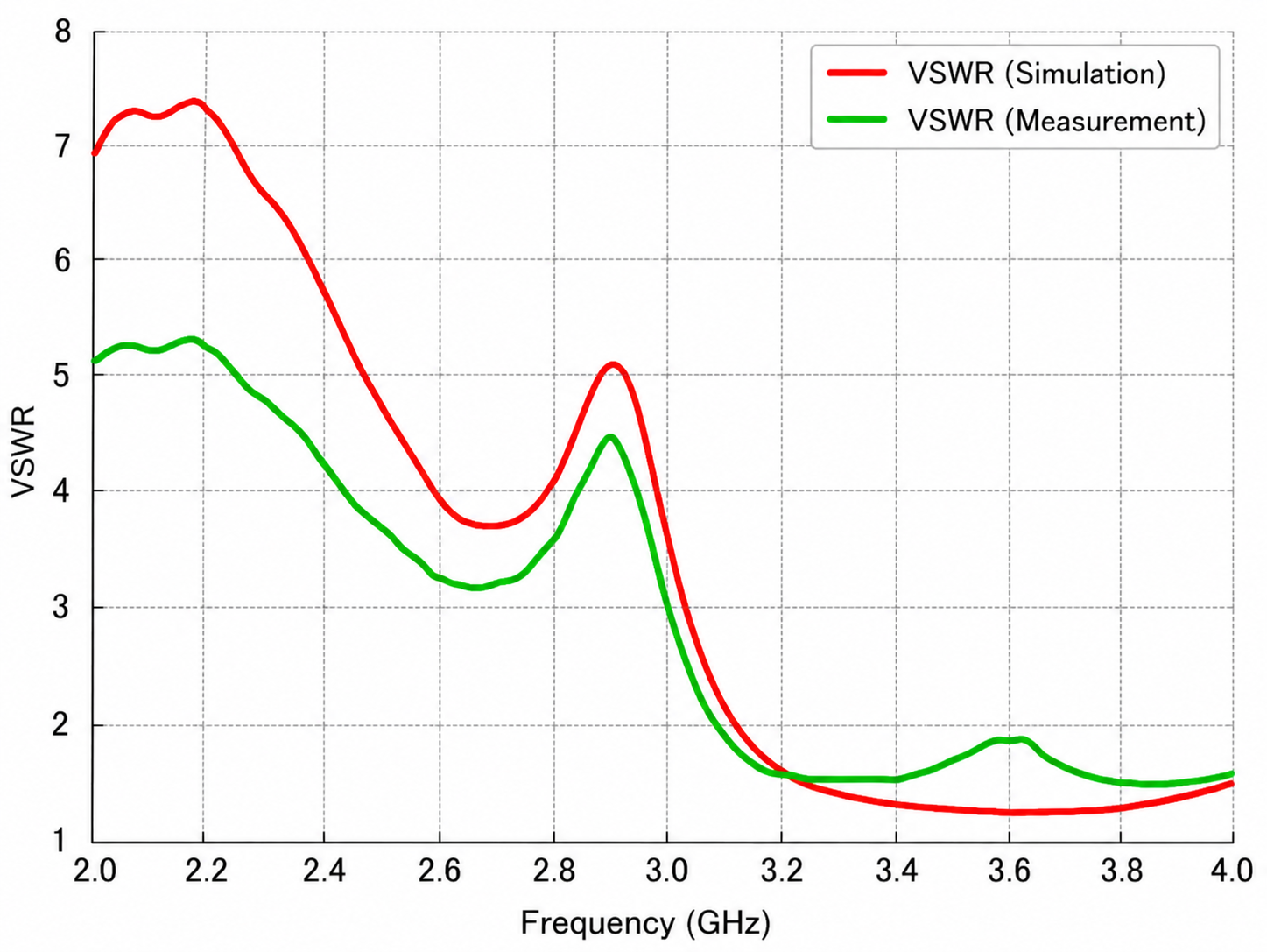
Abstract— Multiple Input Multiple Output (MIMO) technology has become one of the most important techniques for improving data throughput, spectral efficiency, and communication reliability in Long Term Evolution (LTE) wireless systems. The integration of MIMO technology with microstrip antennas offers several advantages, including compact dimensions, lightweight construction, low-profile geometry, and low manufacturing cost. However, conventional microstrip antennas generally suffer from limited bandwidth, relatively low gain, and reduced radiation efficiency. Therefore, antenna optimization techniques are required to improve overall antenna performance. This study presents the design, simulation, fabrication, and performance evaluation of a 2×1 MIMO microstrip antenna operating at the 2.3–2.4 GHz LTE frequency band using the truncated-corner rectangular patch technique. The antenna was designed using CST Studio Suite 2019 and fabricated on an FR-4 substrate with a dielectric constant of 4.3 and substrate thickness of 1.6 mm. The design process involved antenna dimension calculation, parametric optimization, fabrication, and experimental measurement using a Vector Network Analyzer (VNA). Simulation results demonstrated that the proposed antenna achieved a return loss of −15.306 dB, a bandwidth of 989.1 MHz, a Voltage Standing Wave Ratio (VSWR) of 1.414, a gain of 2.291 dBi, and a unidirectional radiation pattern. Measurement results of the fabricated antenna showed a return loss of −10.944 dB and a VSWR value of 1.564. Although differences between simulation and measurement results were observed, the fabricated antenna successfully met the desired LTE operational requirements. The results indicate that the truncated-corner rectangular patch technique can effectively improve impedance matching and radiation characteristics while maintaining compact dimensions suitable for LTE communication applications.
Article Details
How to Cite
References
[1] C. A. Balanis, Antenna Theory: Analysis and Design. New York, NY, USA: John Wiley & Sons, 1997.
[2] A. Iqbal, “Mutual coupling reduction using F-shaped stubs in a UWB-MIMO antenna,” pp. 2755–2759, 2018.
[3] R. D. Jhon, “Design and realization of a 4×4 bow-tie MIMO microstrip antenna at 1.8 GHz for LTE applications,” e-Proceeding of Engineering, Telkom University, Bandung, 2016.
[4] R. Jumita, “Manufacture of tapestry microstrip antennas for ultra-wideband (UWB) applications,” Final Project Report, Politeknik Negeri Padang, 2017.
[5] M. I. E. J., “Design and implementation of a microstrip antenna for a 900 MHz GSM system,” Politeknik Negeri Sriwijaya, Palembang, 2019.
[6] M. I. Prasetyani, S. Alam, and I. Surjati, “Design of a microstrip array antenna using the truncated-corner method with a U-slot at 2.3 GHz,” JTERA (Jurnal Teknologi Rekayasa), pp. 85–92, 2021.
[7] D. Roza, “MIMO systems and their applications,” Technology Engineering, 2013.
[8] E. Sandi, Antennas and Wave Propagation. Jakarta, Indonesia: Universitas Negeri Jakarta, 2013.
[9] M. I. Setiawan, “Design and implementation of a microstrip antenna for a 900 MHz GSM system,” in National Seminar on Innovation and Application of Technology in Industry, 2019, pp. 188–193.
[10] T. Velly, “Design of a band-notched antenna for ultra-wideband applications,” Politeknik Negeri Padang, 2017.
[11] M. Ulfah and S. Mahmudah, “Design, fabrication, and performance evaluation of 2×1 and 4×1 MIMO antennas using a rectangular-patch array for 2.3–2.4 GHz 4G LTE technology,” RESISTOR, pp. 50–56, 2020.